Korean Red Ginseng Benefits: What the Evidence Says + Atomy Hongsamdan
Korean red ginseng is one of the best-known Korean herbal products. Here is what research does and does not show for energy, fatigue and focus, who should be careful, and what is in Atomy Hongsamdan.
By AtomyHealth · Independent Guide · Updated · 8 min read · Who we are
In this article
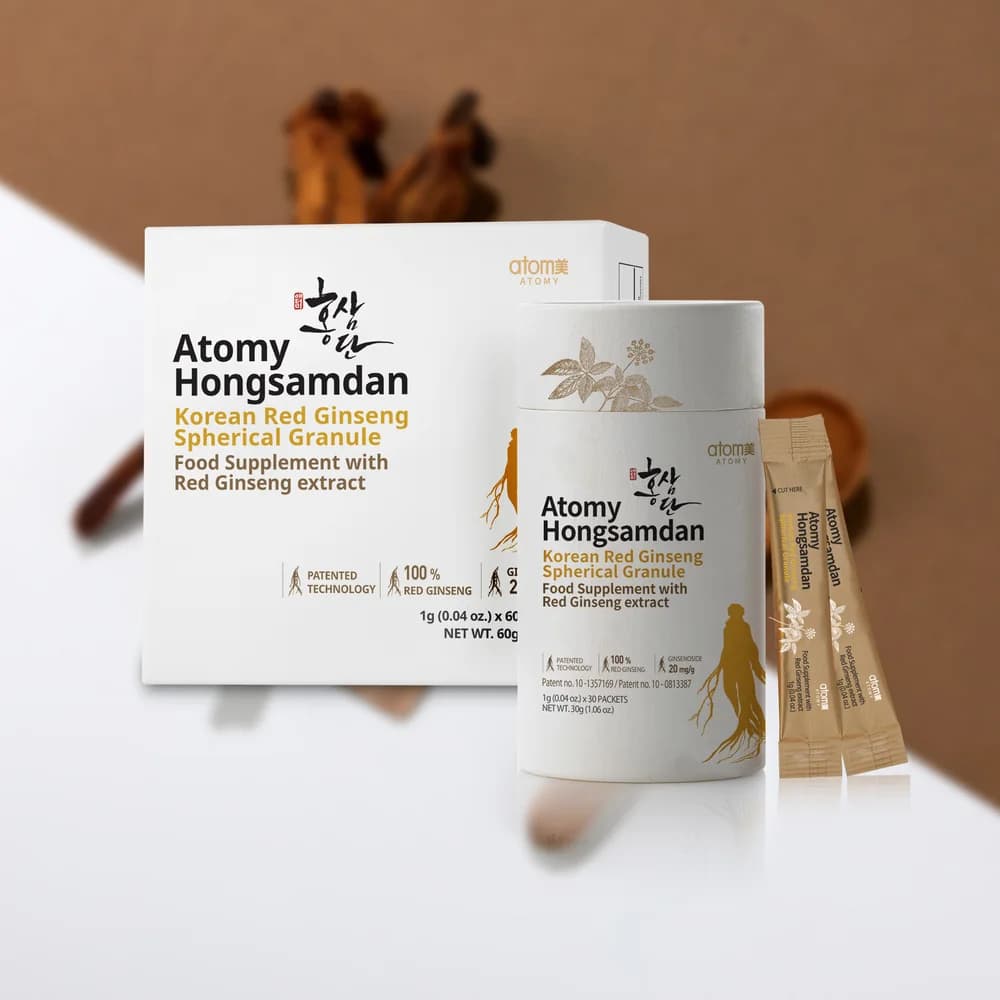
Korean red ginseng (홍삼, hongsam) is the root of Panax ginseng that has been steamed and then dried, which gives it its reddish colour. It has a long place in Korean traditional medicine and is one of Korea's best-known health foods. Atomy's red ginseng product is Atomy Hongsamdan.
This guide covers what is actually known about red ginseng's benefits, including for energy and fatigue, who should be careful, and what Hongsamdan contains.
Short answer: Ginseng has a long traditional use for tiredness and weakness, and some studies suggest a possible small benefit for general fatigue. Evidence for better athletic performance, memory or disease prevention is weak or conflicting. It is usually well tolerated in the short term, but it can interact with some medicines. It is a food supplement, not a medicine.
What is Korean red ginseng?
- Plant: Panax ginseng (Asian or Korean ginseng). It is not the same as American ginseng (Panax quinquefolius) or "Siberian ginseng" (Eleutherococcus), which is a different plant.
- Red vs white: white ginseng is dried raw root; red ginseng is steamed before drying. The process changes the profile of its compounds.
- Root age: roots used for red ginseng are typically several years old (commonly four to six). There is no single "correct" age.
- Ginsenosides: the main group of active compounds. Products often state their ginsenoside content (for example Rg1, Rb1, Rg3).
What does the evidence say?
We base this on three independent sources: the US National Center for Complementary and Integrative Health (NCCIH), the European Medicines Agency (EMA) and a Cochrane review.
Energy and fatigue
- The EMA's herbal committee accepts ginseng root as a traditional herbal medicine "for the symptomatic treatment of asthenia such as fatigue and weakness". That status rests on long-standing use, not on proof from clinical trials; the EMA considered the clinical evidence insufficient for a "well-established use".
- NCCIH reports that a 2023 review found a possible small benefit for general fatigue, although not all research agrees.
So: some people may feel less tired, but the effect, if any, is modest. Persistent tiredness has many causes (sleep, iron deficiency, thyroid, depression, medicines) and is worth checking with a doctor.
Physical performance and stamina
NCCIH: "The majority of research shows that Asian ginseng does not improve athletic performance." Be sceptical of stamina percentages you read online.
Focus and memory
A Cochrane review (Geng et al., 2010) found "a lack of convincing evidence to show a cognitive enhancing effect of Panax ginseng in healthy participants". NCCIH describes the evidence as limited.
Immunity, blood sugar and heart health
NCCIH notes very preliminary research on flu risk and mixed results on blood sugar and cardiometabolic markers; for blood sugar control in diabetes it calls the evidence "inconclusive and conflicting". Red ginseng should not be used to manage diabetes, blood pressure, cholesterol or any other condition.
Sexual function
Some research has looked at ginseng for erectile dysfunction, but this is a medical issue. Talk to a doctor rather than self-treating with supplements.
Safety, side effects and interactions
According to NCCIH:
- Short-term oral use (up to about six months) at recommended amounts appears to be safe for most people; long-term safety is less clear.
- The most common side effect is trouble sleeping. Rare reports include severe rash, liver injury and allergic reactions.
- Ginseng may lower blood sugar: if you take diabetes medicine, ask your doctor first.
- It may affect blood clotting and may worsen autoimmune conditions.
- Some experts advise against use in pregnancy, breastfeeding and in children.
Ask a doctor or pharmacist before taking red ginseng if you take blood thinners, diabetes medicine, immunosuppressants or any other regular medicine, have an autoimmune or bleeding disorder, have surgery planned, or are pregnant or breastfeeding. Taking it in the morning helps if it affects your sleep.
What is in Atomy Hongsamdan?
According to Atomy's product information:
| Atomy Hongsamdan | |
|---|---|
| Form | Small spherical granules in single packets |
| Pack | 60 packets × 1 g |
| Ingredients | 100% Korean red ginseng (97% red ginseng concentrate powder, 3% red ginseng powder) |
| Ginsenosides | 20 mg per packet (stated as Rg1, Rb1 and Rg3) |
| Typical use | 1 packet a day, directly in the mouth or dissolved in water |
Labels can differ by country, so check the pack sold in yours. See the Atomy Hongsamdan product page and our Korean red ginseng ingredient page.
An honest view: Hongsamdan is a convenient way to take red ginseng with a stated ginsenoside content. We have not found published clinical trials on Hongsamdan itself, so the evidence summary above, for red ginseng in general, is what applies.
Where Hongsamdan is sold, and what it costs
Hongsamdan is not on every Atomy mall. We searched the official malls of six English-speaking countries on 22 November 2026:
| Country | Red ginseng product on the mall | Member price |
|---|---|---|
| United States | Hongsamdan (A00107) | $95 |
| United States | Korean Red Ginseng Jelly Stick | $47 |
| Philippines | Hongsamdan Red Ginseng | ₱4,250 |
| Malaysia | Banaba & Red Ginseng, 30 sachets | RM119 |
| Canada, United Kingdom, Australia | none listed | - |
The Malaysian product is a different formula: it combines red ginseng with banaba leaf, so the Hongsamdan table above does not apply to it. The US price was marked as a Black Friday deal on the day we checked. Pack sizes can also differ between countries, so compare the number of packets on the label, not only the price.
How to choose a red ginseng product
- The plant should be Panax ginseng, ideally with the root origin stated.
- A stated ginsenoside content per daily serving.
- Clear dosing on the label, and a manufacturer you can identify.
- No disease claims. A product that promises to cure fatigue, diabetes or sexual problems is a red flag.
Making it part of a routine
Red ginseng works best, if at all, as a small addition to the basics that really drive energy: regular sleep, daily movement, regular meals and stress management (see our Korean stress management guide). Follow the label dose; more is not better.
Atomy also sells HemoHIM, a different herbal product based on angelica, cnidium and peony root. It is not a ginseng product; if you want to know what it is, see the independent guide What is HemoHIM? on hemohimshop.com, our dedicated HemoHIM guide.
Frequently asked questions
Does Korean red ginseng give you energy? It has a traditional use for tiredness, and some studies suggest a small benefit for general fatigue. It is not a stimulant like caffeine, and many people notice little difference.
When is the best time to take red ginseng? Many people take it in the morning, because insomnia is its most common side effect.
How long can I take it? NCCIH says short-term use of up to about six months appears to be safe for most people. Long-term safety is less clear, so ask a healthcare professional about longer use.
Is "Hongsamdan" the Korean word for red ginseng? No. Red ginseng is hongsam (홍삼). Hongsamdan is the name of Atomy's red ginseng granule product.
Where can I buy Atomy Hongsamdan? In November 2026 it was listed on the US mall ($95) and the Philippine mall (₱4,250). We did not find it on the Canadian, UK, Australian or Malaysian malls. Atomy products are sold on Atomy's official mall to registered members. Registration is free and there is no obligation to buy; Atomy closes accounts with no purchase in 6 months or no new purchase in 12 months. See how Atomy membership works.
Medical note: Food supplements are not medicines and are not intended to diagnose, treat, cure or prevent any disease. In the US, the FDA does not approve dietary supplements before they are sold. Ask a doctor or pharmacist before taking red ginseng if you are pregnant or breastfeeding, take medicines, have a chronic condition, or are planning surgery. Not for children unless a doctor advises it.
AtomyHealth is run by an independent, registered Atomy distributor. If you register through our links, we may earn a commission. Prices are the same. General information, not medical advice.
Sources
- National Center for Complementary and Integrative Health (NCCIH). Asian ginseng. https://www.nccih.nih.gov/health/asian-ginseng
- European Medicines Agency, Committee on Herbal Medicinal Products. Ginseng radix (ginseng root). https://www.ema.europa.eu/en/medicines/herbal/ginseng-radix
- Geng J, et al. Ginseng for cognition. Cochrane Database Syst Rev. 2010;(12):CD007769. https://pubmed.ncbi.nlm.nih.gov/21154383/
- US Food and Drug Administration. Dietary supplements. https://www.fda.gov/food/dietary-supplements