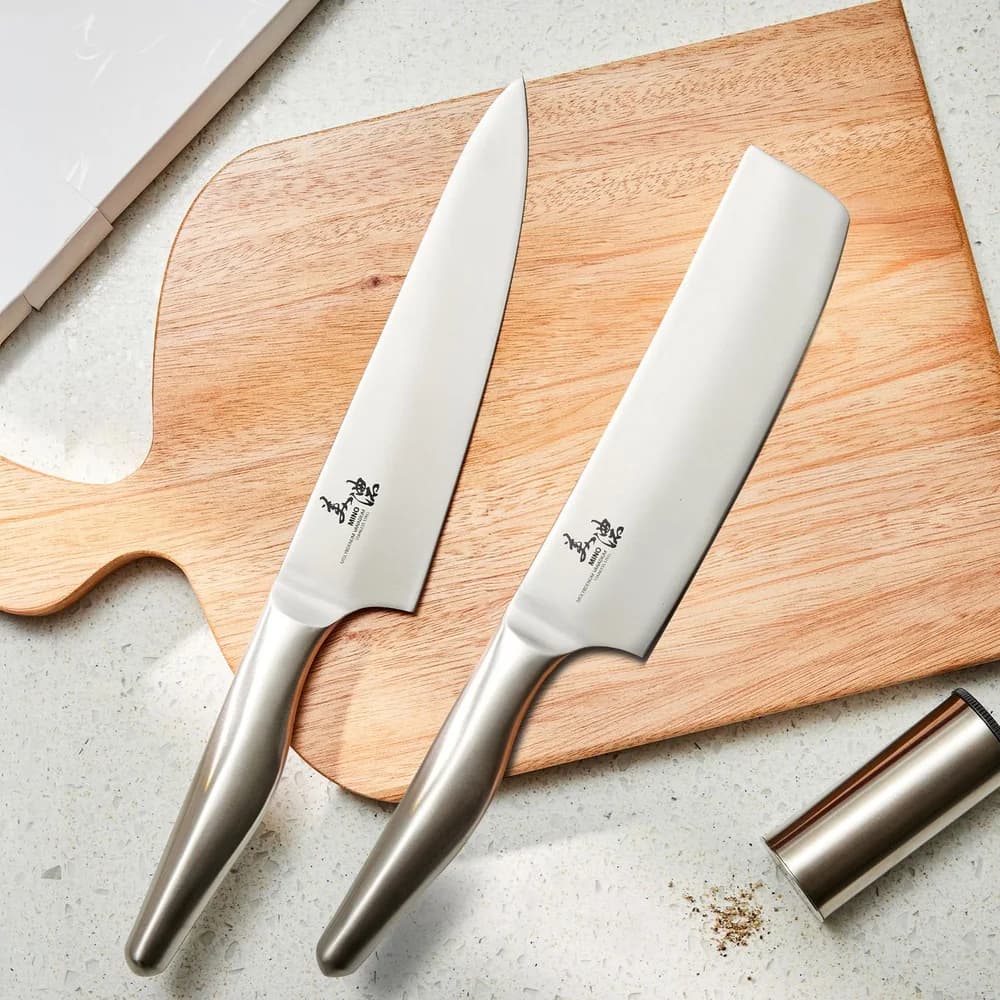
Atomy Kai Mino Knife Set of 2
Chef's knife and nakiri, made in Japan
- Size
- 2 knives: general use (313 mm, blade 180 mm) and vegetables (297 mm, blade 165 mm)
- Product code
- 761509 (EU mall)
The Atomy Kai Mino Knife set brings together two kitchen knives from the Mino brand, made in Japan: a general-use chef's knife and a vegetable knife (nakiri). Atomy describes Mino as a premium line from a Japanese blade company with more than 110 years of history. Each knife is a one-piece stainless steel design with no joint between blade and handle, so food debris has nowhere to collect. The blade is molybdenum-vanadium stainless steel (5Cr15MoV) sharpened to a 30° (±5) angle, and the handle is 18-8 stainless steel (SUS304) shaped for an anti-slip grip. Atomy lists a multi-stage heat treatment, including sub-zero treatment at -70 to -80 °C, to keep hardness even. The chef's knife is 313 mm long with a 180 mm blade; the nakiri is 297 mm with a 165 mm blade and a squared tip. Both weigh 132 g. Hand washing is recommended, not the dishwasher.
Where to buy
Only on Atomy’s official mall in your country, at member prices. Registration is free, with no fees and no obligation to buy. Ranges and prices differ by country.
Where it is listed
This product code is listed on 1 of the 26 Atomy country malls we checked. It can also be sold in another size or under another code, so check your country’s mall before you order.
Checked on 5 November 2026. Links open the product on that country’s official Atomy mall.
Key features
- Two knives: a general-use chef's knife and a vegetable nakiri
- Molybdenum-vanadium stainless steel blade (5Cr15MoV), 30° (±5) edge angle
- One-piece stainless steel (SUS304) handle with no joints for debris to collect
- Multi-stage heat treatment including sub-zero treatment, as Atomy describes
- Chef's knife 313 mm (180 mm blade); nakiri 297 mm (165 mm blade); 132 g each
- Made in Japan
How to use
- 1Before first use, wash with a soft sponge and dishwashing liquid, then dry with a towel.
- 2Use the chef's knife for general prep and meat, and the nakiri for vegetables; always cut on a cutting board.
- 3Wash and dry promptly after use; hand wash only, not in a dishwasher.
- 4Sharpen about once a month with a simple sharpener to keep the edge.
Good for
- Everyday home cooking
- Vegetable prep (nakiri)
- Cooks who want a hygienic one-piece knife
- A kitchen gift
Ingredients
Materials (EU page): blade stainless steel (5Cr15MoV); handle stainless steel (SUS304, 18-8). Blade angle 30° (±5). Country of origin: Japan.
Questions
What knives are in the Atomy Mino Knife set?
The set has two knives. The general-use knife is a chef's knife with a narrow tip, 313 mm long with a 180 mm blade, for most kitchen tasks including meat. The vegetable knife is a nakiri with a squared, less pointed tip, 297 mm long with a 165 mm blade. Atomy lists both at 132 g.
What steel are Atomy Mino knives made of?
Atomy lists the blade as molybdenum-vanadium stainless steel (5Cr15MoV), a high-carbon stainless steel, and the handle as 18-8 stainless steel (SUS304). The knife is a one-piece design, so there is no joint between blade and handle. The edge angle is 30° (±5).
Can Atomy Mino knives go in the dishwasher?
Atomy recommends hand washing. Wipe the blade with a soft sponge and detergent, rinse, and dry it thoroughly with a clean cloth before storing. Although the knives are stainless steel, Atomy notes they can still rust if salt, moisture or acid is left on them. Avoid abrasive scrubbers.
Where are Atomy Mino knives made?
The EU product information gives the country of origin as Japan. Atomy describes Mino as a premium knife brand from a long-established Japanese blade company and says the blades are finished by skilled craftspeople. Warranty sharpening described on the page is handled through the brand's Korean service centre.
How do I keep Atomy Mino knives sharp?
Atomy suggests sharpening the blade about once a month with a simple sharpener. Always cut on a cutting board, avoid twisting the blade sideways, and do not use it on bones, frozen food or other hard objects. Washing and drying right after use also helps protect the edge from rust.
Good to know
- Do not cut bones, crab shells, frozen food, metal or stone; use a deba or frozen-food knife for hard items.
- Avoid side-to-side twisting or impact, which can chip or bend the blade.
- Keep away from flames and out of reach of children; supervise children when using.
- Do not use abrasive scrubbers on the blade.
Storage
- Dry thoroughly after washing to prevent rust; stainless steel can still rust if salt, moisture or acid is left on it.
- For long-term storage, dry completely, wrap in newspaper and keep in a dry, well-ventilated place.
You may also like
Related guides
Follow the label of the product sold in your country. Product photos © Atomy.
Disclosure: AtomyHealth is run by an independent, registered Atomy distributor. If you register through our links, we may earn a commission. Prices are the same. General information, not medical advice.